
Bliss Reduction Program
Commentary by David Lochbaum, GRIP Board Member
President Donald Trump signed Executive Order 14300 on May 23, 2025. Among other things, the Executive Order addressed the U.S. Nuclear Regulatory Commission’s regulations protecting workers and the public from harm caused by exposure to radiation. Executive Order 14300 (EO 14300) contended that:
The NRC utilizes safety models that posit there is no safe threshold of radiation exposure and that harm is directly proportional to the amount of exposure. Those models lack sound scientific basis and produce irrational results, such as requiring that nuclear plants protect against radiation below naturally occurring levels.
The Executive Directive mandated that the NRC:
Adopt science-based radiation limits. In particular, the NRC shall reconsider reliance on the linear no-threshold (LNT) model for radiation exposure and the ‘‘as low as reasonably achievable’’ standard, which is predicated on LNT. Those models are flawed, as discussed in section 1 of this order. In reconsidering those limits, the NRC shall specifically consider adopting determinate radiation limits, and in doing so shall consult with the Department of Defense (DOD), the Department of Energy (DOE), and the Environmental Protection Agency.
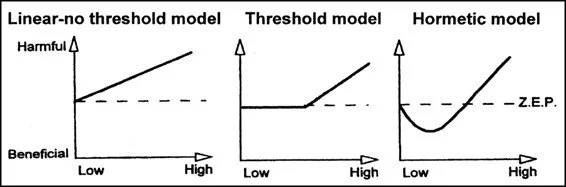
CAPTION: The LNT model (left) assumes there is zero benefit from radiation exposure and that harm increases linearly as radiation exposure increases. The Threshold model (center) assumes there is no discernible harm from radiation exposure below some unspecified amount. The Hormetic model (right) assumes there is a benefit from low radiation doses and no harm occurs until exposure rises about some unspecified amount.
The LNT model (left) assumes there is zero benefit from radiation exposure and that harm increases linearly as radiation exposure increases. The Threshold model (center) assumes there is no discernible harm from radiation exposure below some unspecified amount. The Hormetic model (right) assumes there is a benefit from low radiation doses and no harm occurs until exposure rises about some unspecified amount.
If ignorance is bliss, EO 14300 needs a bliss reduction program. The EO ignored, or improperly dismissed, the reality that the NRC has frequently reconsidered the LNT model and has recently received input from the EPA and other federal and international organizations sustaining it.
The NRC received petitions for rulemaking dated February 9, 2015, February 13, 2015, and February 24, 2015, seeking to compel the agency to revise its radiation protection regulations citing “new science and evidence that contradicts the linear no-threshold (LNT) dose-effect model that serves as the basis for the NRC’s radiation protection regulations.” The petitioners wanted the NRC to revise its regulations to increase the permissible radiation dose to the public to that allowed for nuclear workers and eliminate the lower radiation exposure limit for pregnant women and persons under 18 years of age. The petitioners further contended that low doses of radiation exposure are beneficial to the human body (i.e., the hormesis theory). On August 18, 2021, the NRC denied the three petitions.
The NRC did not reach its decision in a vacuum. The NRC’s denial reported this input from the EPA:
Within limitations imposed by statistical power, the available (and extensive) epidemiological data are broadly consistent with a linear dose-response for radiation cancer risk at moderate and low doses. Biophysical calculations and experiments demonstrate that a single track of ionizing radiation passing through a cell produces complex damage sites in DNA, unique to radiation, the repair of which is error-prone. Thus, no threshold for radiation-induced mutations is expected, and, indeed, none has been observed.
The NRC also reported input from the National Cancer Institute:
… the petitions are selective in citing studies that appear to support hormesis (or a threshold) and omitting mention of the many studies that provide evidence of a dose-response at low doses. In some cases, analyses published many years ago are cited, when more recent analyses based on current follow-up of the same populations, often with improved dose estimates, do not support their claims.
NRC reported input from the National Institute for Occupational Safety and Health (NIOSH):
NIOSH’s comments are based, in part, upon a large study of nuclear workers, completed in 2015, which found that even tiny doses slightly boost the risk of leukemia (the study has been informally referred to as the international nuclear workers or “INWORKS” study). This study included within its cohort over 308,000 nuclear industry workers from the United States, the United Kingdom, and France. The INWORKS study’s authors stated that “[i]n summary, this study provides strong evidence of an association between protracted low dose radiation exposure and leukemia mortality.
The NRC identified many other studies over the past three decades by numerous organizations including the International Atomic Energy Agency, the International Council on Radiation Protection, the National Council on Radiation Protection, the Health Physics Society, and the Advisory Committee on the Medical Uses of Isotopes that continually concluded the LNT model was the most appropriate one. The NRC concluded:
Moreover, the current state of science does not provide compelling evidence of a threshold, as highlighted by the fact that no national or international authoritative scientific advisory bodies have concluded that such evidence exists.
There are over 33 billion reasons to believe the LNT model is the most right, or the least wrong.
In 1990, the U.S. Congress passed the Radiation Exposure Compensation Act (RECA) that compensates workers at the Nuclear Test Site in Nevada, uranium miners, and persons in Nevada, Utah and Arizona living downwind of the atomic bomb testing site for harm from radiation exposure. Through July 16, 2024, RECA paid out $2,693,750,307 for 41,900 claims with roughly half of the compensation given for 26.863 downwinder claims.
In 2000, the Congress passed the Energy Employee Occupational Illness Compensation Program Act (EEOICPA) that compensates workers at nuclear weapons facilities for harm from radiation exposure. Through January 11, 2026, EEOICPA paid out $31.057,956.305 to 151,496 workers.
RECA and EEOICPA have paid out at least $33,751,706,612 to tens of thousands of Americans harmed by exposure to radiation. And claims are still be processed and paid.
The NRC reported:
The petitioners assert that the cost of complying with LNT-based regulations is “enormous” and “incalculable.”
Could that incalculable cost approach or exceed the $33 billion paid to Americans harmed by radiation exposure?
On the road to the EEOICPA, the Congress reported:
Furthermore, studies indicate than 98 percent of radiation-induced cancers within the nuclear weapons complex have occurred at dose levels below existing maximum safe thresholds.
When the overwhelming majority of radiation-induced cancers occurred at doses below the existing thresholds, it would be imprudent and irresponsible to raise the allowable exposure thresholds.
The radiation protection provisions in EO 14300 ignore history and reality. Those provisions should be blissfully ignored.
David Lochbaum wrote a related report, ContamiNATION, for GRIP. It is available here.